 |
omdl
v1.0
OpenSCAD Mechanical Design Library
|
|
omdl
v1.0
OpenSCAD Mechanical Design Library
|
Turtle-style step language to generate coordinate points for polygon construction.. More...
 Collaboration diagram for Turtle:
Files | |
| file | turtle_path.scad |
| Turtle-style step language to generate coordinate points for polygon construction. | |
Functions and/or Modules | |
| function | polygon_turtle_path_p (s, p0=origin2d, h=0, m=0, _s_n=0, _p0_g) |
| Interprets a turtle-style step language to generate coordinate points for polygon construction. More... | |
Turtle-style step language to generate coordinate points for polygon construction..
| Requires: |
|---|
| include <omdl-base.scad>; |
| include <tools/2d/turtle_path.scad>; |
| function polygon_turtle_path_p | ( | s | , |
| p0 | = origin2d, |
||
| h | = 0, |
||
| m | = 0, |
||
| _s_n | = 0, |
||
| _p0_g | |||
| ) |
Interprets a turtle-style step language to generate coordinate points for polygon construction.
| s | <datastruct> The list of steps. |
| p0 | <point-2d> The initial coordinate [x, y]. |
| h | <decimal> The current heading in degrees; 0 = positive x-axis, positive angles rotate counter-clockwise. |
| m | <integer> The return mode. When 0 (default), returns a <point-2d-list>. When 1, returns [point-2d-list, decimal] where the second element is the final heading after all steps have been evaluated. |
| _s_n | <integer> The current step number. |
| _p0_g | <point-2d> The global origin coordinate [x, y]. |
m is 0; (2) <datastruct> [point-2d-list, decimal] when m is 1.The returned list contains the coordinate points of the path described in the list of steps s. When m is 1 the final heading is appended as the second element of the returned pair.
This function is a lightweight interpreter that converts a list of operation steps into coordinate points for polygon construction. It provides a convenient mechanism for defining polygons using a compact, step-based notation inspired by the Turtle graphics geometric drawing language. Each step produces one or more output points according to the schema described below.
Data structure schema:
| name | schema |
|---|---|
| s | [ step, step, ..., step ] |
| step | [ operation, arg1, arg2, arg3, arg4 ] |
The following table summarizes the supported operations, arguments, and their semantics.
| operation | short | arguments | output coordinate point(s) | |
|---|---|---|---|---|
| minimum arguments | extended arguments | |||
heading operations | ||||
| turn_left | tl | a | (none) | |
| turn_right | tr | a | (none) | |
line operations | ||||
| close | cl | (none) | wc, fn | _p0_g |
| goto_xy | gxy | x, y | x, y, wc, fn | [x, y] |
| goto_x | gx | x | x, wc, fn | [x, p0.y] |
| goto_y | gy | y | y, wc, fn | [p0.x, y] |
| delta_xy | dxy | x, y | x, y, wc, fn | p0 + [x, y] |
| delta_x | dx | x | x, wc, fn | p0 + [x, 0] |
| delta_y | dy | y | y, wc, fn | p0 + [0, y] |
| delta_xa | dxa | x, a | x, a, wc, fn | p0 + [ x, x * tan(a) ] |
| delta_ya | dya | y, a | y, a, wc, fn | p0 + [ y / tan(a), y ] |
| move_ar | mar | m, a | m, a, wc, fn | p0 + line(m, a) |
| move_rr | mrr | m, a | m, a, wc, fn | p0 + line(m, h+a) |
| move_fw | mfw | m | m, wc, fn | p0 + line(m, h) |
arc operations | ||||
| arc_fw | afw | r, a | r, a, [o], fn | (see below) |
| arc_pv | apv | c, v, cw, fn | (see below) | |
| arc_vv | avv | v, v, cw, fn | (see below) | |
| arc_blend | ab | p2, p3, r | p2, p3, r, fn | (see below) |
curve operations | ||||
| bezier | bz | ctrl_pts | ctrl_pts, [o], fn | (see below) |
| spline | spl | knots | knots, [o], fn | (see below) |
sub-step operations | ||||
| repeat | rpt | steps | steps, n | (see below) |
| repeat_mx | rptmx | steps, axis | steps, axis, [o] | (see below) |
| repeat_my | rptmy | steps, axis | steps, axis, [o] | (see below) |
| transform | xfrm | steps, r | steps, r, t, mn, [o] | (see below) |
point operations | ||||
| path_p | pp | [p1, p2, ..., pn] | (see below) | |
The two argument columns divide the minimum form from the extended form: the left column shows the minimum required arguments, and the right column shows the extended form with additional optional parameters.
Some operations may generate either straight or periodic waveform lines. When a periodic waveform line is desired, additional parameters specify the waveform configuration and period fragment count as shown in the table above.
| e | data type | default value | parameter description |
|---|---|---|---|
| * | datastruct | required | wc : waveform configuration [p, a, w, m] |
| * | integer | fn : number of facets; optional |
| e | data type | default value | parameter description |
|---|---|---|---|
| 0 | decimal | see below | p : period length |
| 1 | decimal-list-3 | decimal | see below | a : amplitude configuration |
| 2 | datastruct | integer | see below | w : waveform shape configuration |
| 3 | datastruct | integer | see below | m : time-axis remapping mode configuration |
Wave-line constructs a line with periodic waveform lateral displacement to the next point using polygon_line_wave_p(). See its documentation for more details and default value. All line operations accept the optional wc and fn parameters to produce a wave-line in place of a straight segment.
Rotates the current heading counter-clockwise by a degrees. Produces no output coordinate points; only the heading h is updated for subsequent steps.
Rotates the current heading clockwise by a degrees. Produces no output coordinate points; only the heading h is updated for subsequent steps.
Closes the path by returning to the global origin _p0_g with a straight or wave-line segment. When no arguments are given, a straight line is drawn. The global origin is set automatically on the first step and remains fixed for the lifetime of the recursion.
Moves to the absolute coordinate [x, y], ignoring the current position.
Moves to the absolute x-axis coordinate x, retaining the current y-axis coordinate.
Moves to the absolute y-axis coordinate y, retaining the current x-axis coordinate.
Moves from the current position by the relative offset [x, y].
Moves from the current position by the relative x-axis offset x, with no y-axis displacement.
Moves from the current position by the relative y-axis offset y, with no x-axis displacement.
| e | data type | default value | parameter description |
|---|---|---|---|
| 0 | decimal | required | x : x-axis displacement |
| 1 | decimal | required | a : angle in degrees from the x-axis |
Moves from the current position by the relative offset [x, x * tan(a)], where the y-axis displacement is derived from the x-axis displacement x and the angle a. This is convenient when the horizontal extent of a step is known and the slope angle is the natural constraint.
| e | data type | default value | parameter description |
|---|---|---|---|
| 0 | decimal | required | y : y-axis displacement |
| 1 | decimal | required | a : angle in degrees from the x-axis |
Moves from the current position by the relative offset [y / tan(a), y], where the x-axis displacement is derived from the y-axis displacement y and the angle a. This is the complement of delta_xa and is convenient when the vertical extent of a step is known and the slope angle is the natural constraint.
| e | data type | default value | parameter description |
|---|---|---|---|
| 0 | decimal | required | m : radial distance |
| 1 | decimal | required | a : absolute angle in degrees |
Moves from the current position by distance m at the absolute angle a, measured from the positive x-axis. The heading h is not consulted.
| e | data type | default value | parameter description |
|---|---|---|---|
| 0 | decimal | required | m : radial distance |
| 1 | decimal | required | a : angle offset in degrees relative to current heading |
Moves from the current position by distance m at an angle of h + a, where h is the current heading. When a is zero this operation is equivalent to move_fw.
Moves forward from the current position by distance m along the current heading h. Equivalent to move_rr with a set to zero.
| e | data type | default value | parameter description |
|---|---|---|---|
| 0 | decimal | required | r : arc radius; must be positive |
| 1 | decimal | required | a : signed sweep angle in degrees; positive = CCW (left turn), negative = CW (right turn) |
| 2 | datastruct | [update_heading]; optional; assign undef to accept all option defaults when only fn is needed | |
| 3 | integer | fn : number of facets; optional |
| e | data type | default value | parameter description |
|---|---|---|---|
| 0 | boolean | true | update_heading : when true the heading is advanced by a degrees on exit; when false the entry heading h is restored |
Sweeps an arc of radius r through the signed angle a starting from the current position p0 and following the current heading h. The arc center lies perpendicular to h at distance r: to the left (h + 90°) when a is positive and to the right (h - 90°) when a is negative. The arc is delegated to polygon_arc_sweep_p(). Returns empty_lst when a is zero. By default the heading is updated to h + a on exit, so chained arc_fw steps flow naturally without manual heading bookkeeping. Pass [o] = [false] to suppress the heading update. Pass [o] = undef to accept all option defaults while still supplying fn.
| e | data type | default value | parameter description |
|---|---|---|---|
| 0 | point-2d | required | c : arc center point [x, y] |
| 1 | point-2d | decimal | required | v : arc stop angle [x, y] or a |
| 2 | boolean | required | cw : arc sweep direction |
| 3 | integer | fn : the number of facets; optional |
This operation constructs an arc about a center point specified as a coordinate. The arc begins at the angle defined by the vector [c, p0] and ends at the angle defined by either the vector [c, v] or by the scalar angle v (in degrees). The sweep direction is controlled by cw; when cw is set to true, the arc is swept clockwise from the start angle to the stop angle. The optional parameter fn specifies the number of facets and, when omitted, is determined automatically by get_fn().
| e | data type | default value | parameter description |
|---|---|---|---|
| 0 | decimal-list-2 | required | c : arc center point [m, a] |
| 1 | point-2d | decimal | required | v : arc stop angle [x, y] or a |
| 2 | boolean | required | cw : arc sweep direction |
| 3 | integer | fn : number of facets; optional |
This operation constructs an arc about a center point specified as a vector [m, a] originating from the current position. The arc begins at the angle defined by the vector [c, p0] and ends at the angle defined by either the vector [c, v] or by the scalar angle v (in degrees). The sweep direction is controlled by cw; when cw is set to true, the arc is swept clockwise from the start angle to the stop angle. The optional parameter fn specifies the number of facets and, when omitted, is determined automatically by get_fn().
| e | data type | default value | parameter description |
|---|---|---|---|
| 0 | point-2d | required | p2 : corner vertex coordinate [x, y]; the point where the two segments meet |
| 1 | point-2d | required | p3 : end point of the outgoing segment [x, y] |
| 2 | decimal | required | r : blend radius; must be positive |
| 3 | integer | fn : number of facets; optional |
Replaces the sharp corner at p2 with a circular arc of radius r that is tangent to both the incoming segment [p0, p2] and the outgoing segment [p2, p3]. The current position p0 supplies the start point of the incoming segment. Only the arc points are emitted; the corner vertex p2 is not included. Delegates to polygon_arc_blend_p(). The heading h is not updated by this operation.
| e | data type | default value | parameter description |
|---|---|---|---|
| 0 | point-2d-list | required | ctrl_pts : Bézier control point list [[x, y], ...] |
| 1 | datastruct | [prepend_p0]; optional; assign undef to accept all option defaults when only fn is needed | |
| 2 | integer | fn : number of facets; optional |
| e | data type | default value | parameter description |
|---|---|---|---|
| 0 | boolean | true | prepend_p0 : when true the current position p0 is automatically prepended to ctrl_pts as the first control point |
Evaluates a degree-n Bézier curve defined by the control point list ctrl_pts using the de Casteljau algorithm. When prepend_p0 is true (the default) the current position p0 is inserted as the first control point so the curve departs smoothly from the last emitted point. Pass [o] = [false] when ctrl_pts already contains the intended start point. Pass [o] = undef to accept all option defaults while still supplying fn. The heading h is not updated by this operation. Delegates to polygon_bezier_p().
| e | data type | default value | parameter description |
|---|---|---|---|
| 0 | point-2d-list | required | knots : Catmull-Rom knot list [[x, y], ...] |
| 1 | datastruct | [prepend_p0, closed]; optional; assign undef to accept all option defaults when only fn is needed | |
| 2 | integer | fn : facets per segment; optional |
| e | data type | default value | parameter description |
|---|---|---|---|
| 0 | boolean | true | prepend_p0 : when true the current position p0 is automatically prepended to knots as the first knot |
| 1 | boolean | false | closed : when true a closing segment is added from the last knot back to the first knot |
Evaluates a centripetal Catmull-Rom spline through the knot list knots. The curve passes through every knot point. When prepend_p0 is true (the default) the current position p0 is inserted as the first knot so the spline departs from the last emitted point. When closed is true a closing segment from the last knot back to the first is included. Pass [o] = undef to accept all option defaults while still supplying fn. The heading h is not updated by this operation. Delegates to polygon_spline_p().
| e | data type | default value | parameter description |
|---|---|---|---|
| 0 | datastruct | required | steps : sub-step list |
| 1 | integer | 1 | n : number of repetitions; optional |
Evaluates the sub-step list steps n times in sequence. Each iteration begins where the previous left off, carrying p0, h, and _p0_g forward between iterations. The heading evolved inside the sub-steps carries back into the outer step list after all iterations complete. When n is omitted the sub-steps are evaluated once, making repeat useful as a plain grouping mechanism. Nesting is supported to arbitrary depth.
| e | data type | default value | parameter description |
|---|---|---|---|
| 0 | datastruct | required | steps : sub-step list |
| 1 | decimal | 0 | axis : scalar offset of the mirror axis from p0 along the y-axis; optional |
| 2 | datastruct | o : options [reverse, heading, mirror_start]; optional |
| e | data type | default value | parameter description |
|---|---|---|---|
| 0 | boolean | true | reverse : reverse the mirrored point list for correct polygon winding |
| 1 | boolean | true | heading : when true, carry the final heading of the forward pass back into the outer step list; when false, restore the entry heading |
| 2 | boolean | true | mirror_start : begin the mirrored pass from p0; when false, begin from the end of the forward pass |
Evaluates steps once to produce a forward point list, then mirrors all output points about a horizontal axis at p0.y + axis. The mirrored list is appended after the forward list to produce a top-bottom symmetric profile in a single operation. The options bundle o controls winding order, heading continuity, and the start point of the mirrored pass. Nesting is supported to arbitrary depth.
| e | data type | default value | parameter description |
|---|---|---|---|
| 0 | datastruct | required | steps : sub-step list |
| 1 | decimal | 0 | axis : scalar offset of the mirror axis from p0 along the x-axis; optional |
| 2 | datastruct | o : options [reverse, heading, mirror_start]; optional |
| e | data type | default value | parameter description |
|---|---|---|---|
| 0 | boolean | true | reverse : reverse the mirrored point list for correct polygon winding |
| 1 | boolean | true | heading : when true, carry the final heading of the forward pass back into the outer step list; when false, restore the entry heading |
| 2 | boolean | true | mirror_start : begin the mirrored pass from p0; when false, begin from the end of the forward pass |
Evaluates steps once to produce a forward point list, then mirrors all output points about a vertical axis at p0.x + axis. The mirrored list is appended after the forward list to produce a left-right symmetric profile in a single operation. The options bundle o controls winding order, heading continuity, and the start point of the mirrored pass. Nesting is supported to arbitrary depth.
| e | data type | default value | parameter description |
|---|---|---|---|
| 0 | datastruct | required | steps : sub-step list |
| 1 | decimal | required | r : rotation angle in degrees, applied about p0 |
| 2 | point-2d | [0, 0] | t : translation vector [x, y]; optional |
| 3 | vector-2d | undef | mn : mirror normal vector [nx, ny]; applied before rotation; optional |
| 4 | datastruct | o : options [update_p0, update_h]; optional |
| e | data type | default value | parameter description |
|---|---|---|---|
| 0 | boolean | false | update_p0 : when true, advance the parent p0 to the last transformed point after the operation |
| 1 | boolean | o[0] | update_h : when true, update the parent h to h_final + r after the operation; defaults to update_p0 when not specified |
Evaluates steps to produce a point list, then applies a 2D affine transformation to every output point via transform_p(). Mirror mn is applied first about the entry position p0, followed by rotation r about p0, then translation t. When mn is undef no mirror is applied. When both options are false (the default) the parent p0 and h are unchanged after the operation, making transform a pure geometric post-processor. update_p0 and update_h may be set independently: for example, pass [true, false] to advance p0 to the last transformed point while preserving the entry heading, or [false, true] to carry the rotated heading forward while keeping the turtle anchored at its entry position. When only update_p0 is supplied (e.g. [true]), update_h inherits the same value. Nesting is supported to arbitrary depth.
| e | data type | default value | parameter description |
|---|---|---|---|
| 0 | point-2d-list | required | path list of 2d points |
Inserts a list of 2D points [x, y] into the output at the current step, specified as a single argument containing the point list. Care should be taken to ensure a smooth transition between the end of the previous step and the start of the inserted points.
Motor mount plate design example script
| top | diag |
|---|---|
 | 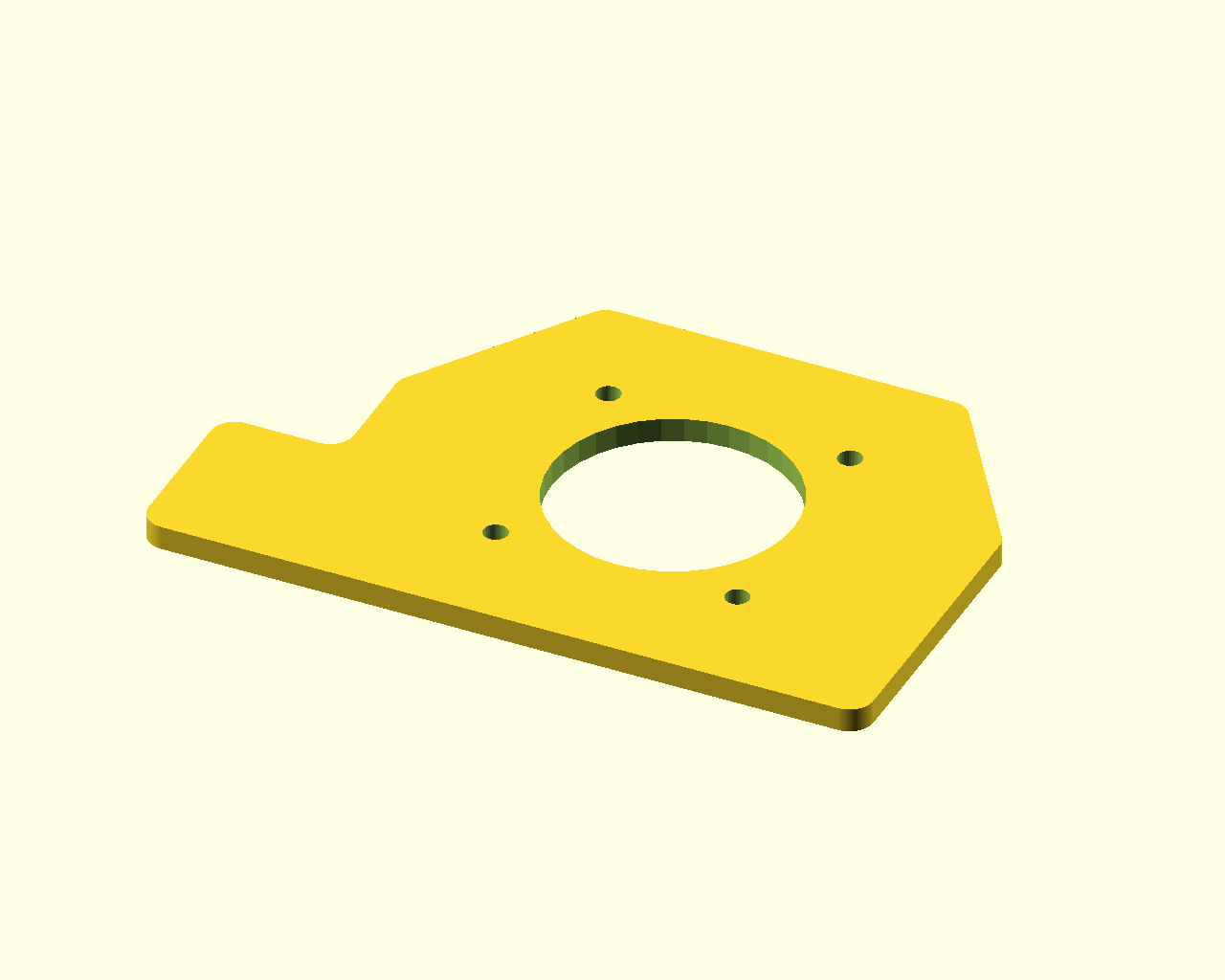 |
The corners of this example 2d design plate have been rounded with the library function polygon_round_eve_all_p().